Reading the score

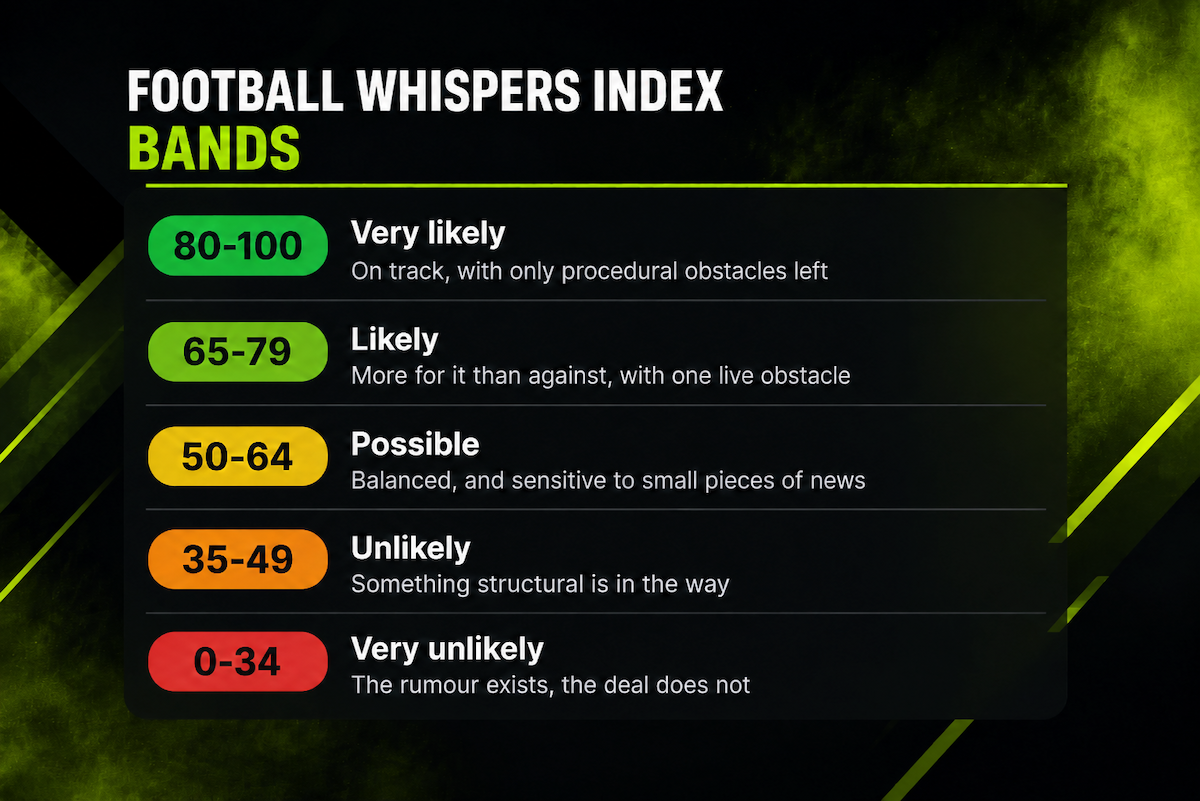
Every Football Whispers Index card carries the overall transfer score, the likelihood band, a brief summary and five pillars showing which parts of the case are strong and which are not.
The bars matter as much as the total, because two rumours can both score 57 for completely different reasons.
The five things that make up the score
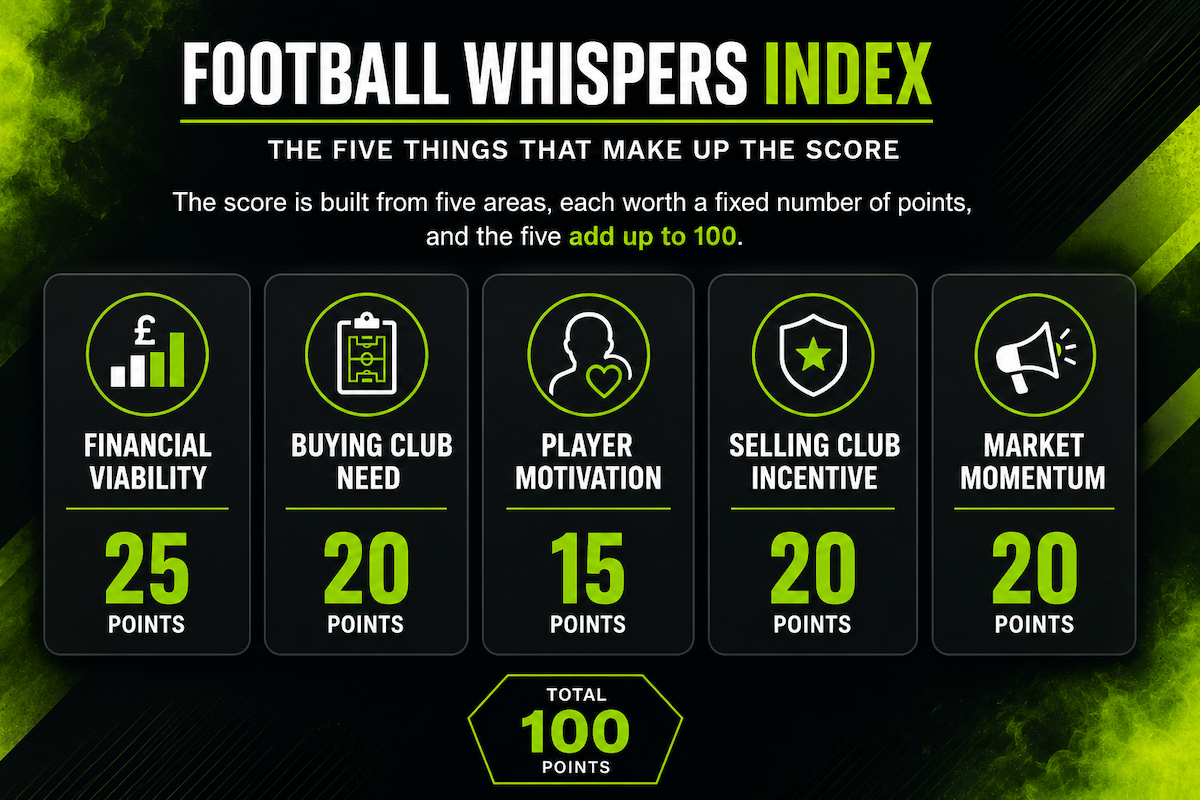
The score is built from five areas, each worth a fixed number of points, which all add up to a maximum score of 100.
Financial viability: 25 points. Can the buying club actually afford this?
Buying club need: 20 points. Do they need this player, in this role, at this age?
Player motivation: 15 points. Does the player want to go?
Selling club incentive: 20 points. Why would the player’s current club accept the deal?
Market momentum: 20 points. How credible is the rumour itself?
1. Financial viability
The first thing we test is the fee against the buyer’s size, by dividing the reported fee by the club’s annual revenue. The richest clubs in the world score higher here than those working on tight budgets.
A £40m fee is routine for Liverpool on revenue of €836.1m and close to a club record for Brentford on €206.0m, so the same number means very different things.
Next is the wage, compared with what the club already pays its highest earner, because a signing who would immediately become the best-paid player at the club is a much harder internal sell than one who slots into the existing structure.
Then comes the spending rules, which from the 2026/27 season means the Premier League’s Squad Cost Ratio rather than the old PSR loss limit.
The Squad Cost Ratio holds a club’s wages, transfer fee amortisation and agent fees to 85% of its football revenue, and clubs in UEFA competition face a tighter 70% limit, so a club pushed against either line cannot buy without selling first.
Last in this section is contract length; a short contract scores higher, because a player with 12 months left is far easier to prise away than one who still has years left to run.
2. Buying club need
We look at the specific role rather than the position, because a club with three central midfielders and no holding midfielder has a gap even though the position looks full.
Squad depth charts and the club’s own summer business decide this, so a club that has just sold its first-choice option in that role scores higher than one that has just bought one.
Then we compare the target directly with the man currently in the shirt, on the same per-90 or percentile basis rather than on reputation, and a clear improvement of more than 15% on the key metric for that role scores highest.
Age is the third part, judged against how that particular club recruits rather than against a universal ideal, so a 30-year-old is a mismatch at a club buying for resale value and a sensible fit at one buying for experience or two seasons of immediate output.
3. Player motivation
Three things decide whether the player is pulling towards the move.
Whether it is a step up, sideways or down, measured on the clubs’ standing and their European football rather than on history.
Whether he would start, because a guaranteed starting place is a far stronger pull than a rotation role, and an unclear situation is weaker again.
And what has actually been said in public, which covers his own quotes, briefings from his representatives, a refusal to sign an extension and anything else on the record.
Silence scores low here, and so does a public commitment to his current club.
4. Selling club incentive
A transfer needs a willing seller, and plenty of rumoured deals die because there is no reason for the selling club to say yes.
We score whether the club needs the money, judged on its accounts, wage bill and its financial headroom rather than on speculation.
We score whether a replacement is already lined up, because a club is unlikely to leave itself short in a position it cannot refill.
The player’s form trend is also factored in, since a club sells a declining asset far more readily than an improving one, while the trading model of the club – whether they tend to cash in on players at peak value or offload later in careers – is also reflected.
5. Market momentum
This is where the rumour itself is judged, and it is the part of the model closest to the original Football Whispers Index.
Who broke it carries the most weight, so a tier-one reporter with a long record of accuracy scores full marks, a tier-two outlet scores lower, a tabloid-only story lower again, and a social-media-only claim scores the minimum.
How many independent outlets have it comes next, and to score highly here the reports must be truly independent – not numerous accounts stemming from the same original source. This enables the model to cut through the noise and reward corroboration over column inches.
And we score strategic logic, meaning whether there is a concrete real-world link such as a manager who has coached the player before, a shared agent, or an established trading relationship between the two clubs.
The competition layer
Everything above scores one club chasing one player, which is not how a transfer window works, so a second layer adjusts the total.
How crowded the race is comes first, and a club that is the only credible suitor gains points while a club trailing in a three-way race loses them.
The level of the competitors comes next, so a rival rated six or more points higher in the Opta Power Rankings is a serious problem and a rival the buyer clearly outranks is not.
That penalty is then scaled by how live the rival actually is, because a strong club with a passing interest should not drag a score down the way a strong club in advanced talks does.
Whether the player is the buyer’s first choice matters too, since a clear sole priority gains points and a player who is one of three names on a shortlist for one slot loses them.
How far the negotiation has got is scored directly, from an agreed fee at the top down through progressing talks and early enquiries to an open standoff or a deal stalled entirely over valuation.
The timing in the window is also considered on a case-by-case basis; a late deal can often be more likely to go through as clubs rush to do more business before the deadline, but it can also make a transfer less likely to materialise if the player is important for the selling club and they would have no time to find a replacement.
And we score whether the seller will resist this particular buyer, because a fierce derby rivalry is a real obstacle in a way that a foreign buyer is not, and Liverpool selling to Manchester United is not the same transaction as Liverpool selling to Bayern Munich.
The personal terms rule
One thing overrides almost everything else, which is a player who has already agreed personal terms.
Whoever has the player’s agreement usually wins the race regardless of fit, so if a rival club has agreed terms we cap the score at 45, and if the buying club has agreed terms we floor it at 75.
There is one judgement attached to that floor, which is that terms agreed weeks ago on a deal that has since gone cold do not count, because an old handshake is not a live negotiation.
The wealth adjustment
The Opta Power Rankings measure how good a team is on the pitch, which is exactly what you want when a Champions League club is competing with a mid-table one.
It is the wrong measure when the rival is a Saudi Pro League club, because a side ranked outside the European elite can still outbid all of them.
So when the strongest rival competes on money rather than level, and the move is a realistic one for that player, we override the Opta ranking and treat that rival as a top-tier threat.
Verified by experts
Every rumour scored by the Football Whispers Index is checked, challenged and verified by our in-house team of transfer experts.
Every transfer is unique and it impossible for an algorithm to account for every possible component of every potential deal.
Therefore, each score gets a human sanity check before being published.
The rules we hold ourselves to
All stats, claims and reported fees are thoroughly sourced, and nothing will make it to a Football Whispers Index scorecard without being backed up by multiple outlets – unless that is a reason for marking the rumour likelihood down.
Where only one outlet has a figure, we score it and say the figure is unconfirmed rather than presenting it as settled.
We count originators rather than republishers, so syndication cannot inflate a score.
And scores are rescored when the story moves, which means a stalled deal falls and an agreement jumps, rather than sitting still until the window closes.
The new Football Whispers Index model was designed and built by Barney Corkhill.

/https%3A%2F%2Fmedia.footballwhispers.com%2Fmain%2F2026%2F10%2FUnknown-3-2.png)
/https%3A%2F%2Fmedia.footballwhispers.com%2Fmain%2F2026%2F10%2FChelsea-Sprint-Through-Neon-Smoke-e1792768728642.png)
/https%3A%2F%2Fmedia.footballwhispers.com%2Fmain%2F2026%2F10%2FArsenal-Star-in-Neon-Green-Spotlight-e1792713766592.png)
/https%3A%2F%2Fmedia.footballwhispers.com%2Fmain%2F2026%2F10%2FArsenal-Captain-Amid-Electric-Lightning.png)
/https%3A%2F%2Fmedia.footballwhispers.com%2Fmain%2F2026%2F10%2FNeon-Liverpool-Football-Portrait-1.png)
/https%3A%2F%2Fmedia.footballwhispers.com%2Fmain%2F2026%2F10%2FElectric-Footballer-in-Neon-Lightning-e1792412630646.png)
/https%3A%2F%2Fmedia.footballwhispers.com%2Fmain%2F2026%2F10%2Figor-gr.jpg)
/https%3A%2F%2Fmedia.footballwhispers.com%2Fmain%2F2026%2F10%2FArsenal-Footballer-in-Neon-Smoke.png)