Mega Millions vs Powerball: Which Lottery Should You Actually Play?

Mega Millions vs Powerball: Which Lottery Should You Actually Play?

The question of Mega Millions vs Powerball comes down to the ticket cost against lottery odds. Mega Millions has better jackpot odds at 1 in 290,472,336 against Powerball’s 1 in 292,201,338. The same goes for any-prize odds, but Mega Millions costs $5 a play to Powerball's $2 per ticket.

Both lottery games offer 9 prize tiers and the same pick-5-plus-1 format, so another big decision factor for a lotto player is what $10 buys: 2 plays of the $5 Mega Millions game or 5 of the $2 Powerball game. We checked every figure against the official lottery sources in November 2026.

Mega Millions vs Powerball: Quick Comparison of Jackpot Odds, Number Pools & Ticket Costs

For a quick Mega Millions vs Powerball comparison, the $5 game wins on odds per play, and the $2 game wins on price. Every figure below was verified in November 2026.

Metric/Game Mega Millions Powerball
Main number field Pick 5 from 1 to 70 Pick 5 from 1 to 69
Bonus number field Mega Ball from 1 to 24 Powerball from 1 to 26
Ticket price $5 $2
Multiplier Built in, 2x to 10x Power Play, +$1, 2x to 10x
Prize tiers 9 9
Jackpot odds 1 in 290,472,336 1 in 292,201,338
Odds of winning any prize 1 in 23.07 1 in 24.87
Starting (seed) jackpot $50 million $20 million
Draw schedule Tuesdays and Fridays Mondays, Wednesdays and Saturdays

Figures checked against the official Mega Millions and Powerball pages, November 2026.

If you live in Georgia, Kentucky, New Hampshire, Pennsylvania or Virginia, you can buy both games online through your state lottery, and each has a new-player offer to get you started:


GA Lottery
50% Deposit Match up to $125

LOTTOGA

Sign Up


  • Licensed in: US
Terms and conditions:
Terms & Conditions Apply.

KY Lottery
Get a 100% deposit match up to $250

KYBONUS

Sign Up

  • Verified today by our team

  • Licensed in: US
Terms and conditions:
18+. Terms & Conditions Apply.

NH Lottery promo code
200% deposit match bonus up to $100

NHCODE

Sign Up


  • Licensed in: US
Terms and conditions:
Terms & Conditions Apply.

PA Lottery
Get a first deposit match up to $1,000

LOTTOPA

Sign Up


  • Licensed in: US
Terms and conditions:
For first time deposit. Terms & conditions apply.

VA Lottery
50% deposit match up to $100

LOTTOVA

Sign Up


  • Licensed in: US
Terms and conditions:
Terms & Conditions Apply.

Before you buy any ticket online, check out our guide to the best US online lotteries.

What Changed in Mega Millions in April 2025?

Mega Millions was overhauled for the April 8, 2025 drawing, which is why so many comparisons online are now out of date. Four things changed:

  • Price: a play went from $2 to $5.
  • Mega Ball pool: it shrank from 25 to 24 numbers, which moved the jackpot odds from 1 in 302,575,350 to 1 in 290,472,336 and the odds of winning any prize from about 1 in 24 to 1 in 23.07.
  • Multiplier: a random 2x to 10x multiplier is now built into every play, so the optional $1 Megaplier and the Just the Jackpot wager some states offered are gone.
  • Starting jackpot: it resets to $50 million after a win, up from $20 million.

If an article still says Mega Millions costs $2 or talks about adding the Megaplier, it is describing a game that no longer exists.

How Do the Rules of Mega Millions and Powerball Compare?

Both games use the same pick-5-plus-1 format, and the differences come down to pool sizes: 70 white balls and 24 Mega Balls in Mega Millions, 69 white balls and 26 Powerballs in Powerball. Powerball players pick 5 white balls from 1 to 69 and 1 red Powerball from a pool of 1 to 26. That ticket matrix produces 292,201,338 number combinations, and matching all 6 takes the jackpot. Our Powerball guide walks through the slip.

Mega Millions players pick 5 white balls from 1 to 70 and 1 gold Mega Ball from 1 to 24. That number matrix holds 290,472,336 combinations. For a full ticket and rules breakdown, read our guide on how to play Mega Millions lottery.

The differences in game formats boil down to 3 numbers:

  • White ball pool: 70 numbers in Mega Millions, 69 in Powerball.
  • Bonus ball pool: 24 Mega Balls against 26 Powerballs.
  • Net effect: the combinatorics favor Mega Millions by 1,729,002 combinations.

Mega Millions vs Powerball Odds: Which Is Harder to Win?

Mega Millions beats Powerball on both jackpot and overall odds. Mega Millions jackpot odds are 1 in 290,472,336 and its overall odds of winning (any-prize odds) are 1 in 23.07, against 1 in 292,201,338 and 1 in 24.87 for Powerball. Powerball is the harder game on both counts.

Prize tier (match) Mega Millions odds Powerball odds
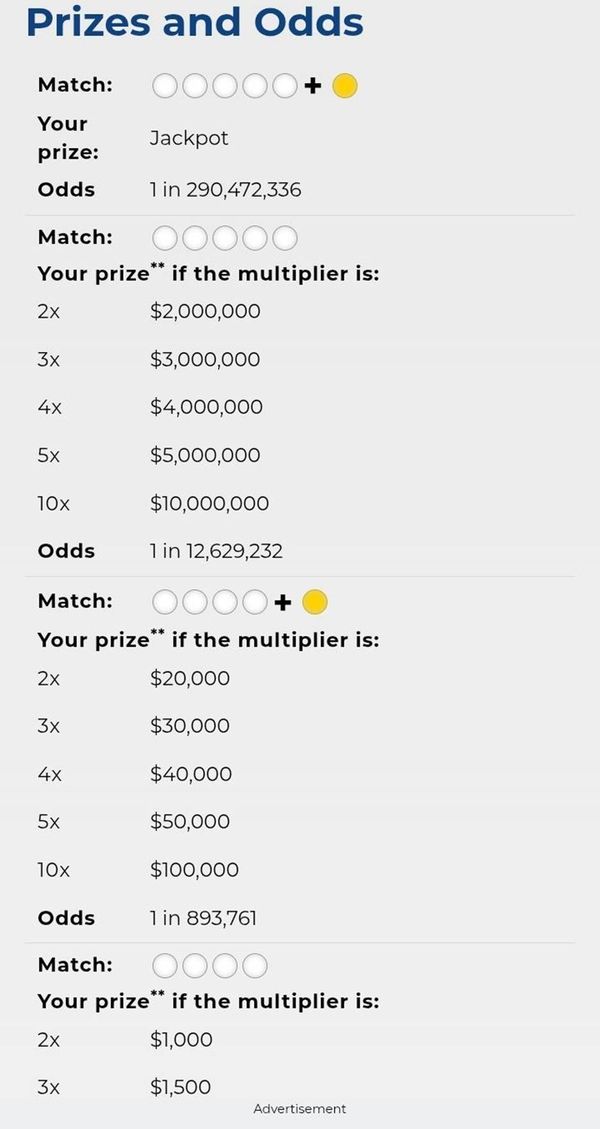
5 + bonus ball (jackpot) 1 in 290,472,336 1 in 292,201,338
5, no bonus ball 1 in 12,629,232 1 in 11,688,053.52
4 + bonus ball 1 in 893,761 1 in 913,129.18
4, no bonus ball 1 in 38,859 1 in 36,525.17
3 + bonus ball 1 in 13,965 1 in 14,494.11
3, no bonus ball 1 in 607 1 in 579.76
2 + bonus ball 1 in 665 1 in 701.33
1 + bonus ball 1 in 86 1 in 91.98
0 + bonus ball 1 in 35 1 in 38.32
Odds of winning any prize 1 in 23.07 1 in 24.87

Odds verified against the official Mega Millions and Powerball odds pages, November 2026.

The jackpot odds comparison is a rounding error: 1,729,002 extra combinations in a pool of 290 million is a 0.6% gap.

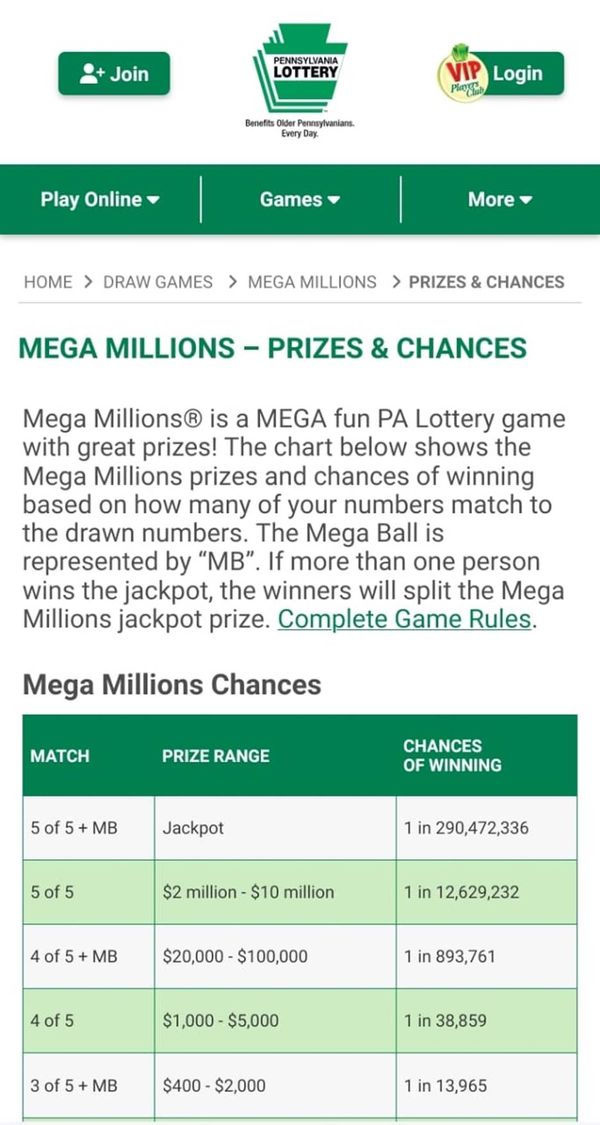
Mega Millions jackpot odds verified November 10, 2026 on PA Lottery website

Has Anyone Ever Won Mega Millions on a Quick Pick?

Yes, and recently. A Quick Pick sold at a Sugar Land, Texas gas station won $800 million in September 2024, and an Illinois player won $536 million online in March 2026 after starting from a Quick Pick. Georgia’s $980 million winner, sold at a Newnan Publix in November 2025, was reported as a Quik Pik.

A Quick Pick does not change the math. Every combination has the same 1 in 290,472,336 chance, and past draws tell you nothing about the next one, so hot and cold numbers are noise.

Mega Millions vs Powerball Ticket Cost: Is One a Better Value?

Mega Millions gives you better odds per $5 play, and Powerball gives you 2.5 times the plays per dollar, as the $10 comparison below shows. The Powerball ticket cost is $2 a play. Power Play adds $1, and Double Play adds another $1 for a second drawing with a $10 million top prize, in the states that offer it. Idaho and Montana bundle Power Play in at a $3 minimum.

The two tickets differ by $3 a play, because Mega Millions tickets cost $5 with the multiplier built in.

  • For Mega Millions, the multiplier is randomly assigned at purchase (2x, 3x, 4x, 5x or 10x) and applies to every non-jackpot prize.
  • Power Play: an optional $1 multiplier, with 10x offered only when the advertised jackpot is $150 million or less.
  • Match 5: Power Play fixes the prize at $2 million, while Mega Millions pays $2 million to $10 million.

Mega Millions vs Powerball: What $10 Buys in Each Game

Per play, Mega Millions has the better odds of winning a jackpot or any prize. Powerball switches the match when you consider the jackpot odds per dollar. Here’s how they compare on the two factors:

Per $10 spent Mega Millions Powerball
Plays 2 5
Jackpot chance 1 in 145,236,168 1 in 58,440,268
Prizes won, on average 0.09 0.20
Average non-jackpot prize value $2.24 $1.60

Odds verified against the official Mega Millions and Powerball odds pages, November 2026.

These are our calculations from the official odds and prize tables. The prize value is an expected value that leaves out the jackpot and Power Play, and it uses the 3x average multiplier implied by the published multiplier odds.

How Do Mega Millions and Powerball Prizes Compare?

Both games have 9 prize tiers, and the match-5 with no extra ball tier is where they differ most. Mega Millions pays $2 million to $10 million, while Powerball pays $1 million. Here are the prize tiers:

Match/Prize Tier Mega Millions base Mega Millions with multiplier (2x to 10x) Powerball
5 + bonus ball Jackpot Jackpot Jackpot
5, no bonus ball $1,000,000 $2,000,000 to $10,000,000 $1,000,000
4 + bonus ball $10,000 $20,000 to $100,000 $50,000
4, no bonus ball $500 $1,000 to $5,000 $100
3 + bonus ball $200 $400 to $2,000 $100
3, no bonus ball $10 $20 to $100 $7
2 + bonus ball $10 $20 to $100 $7
1 + bonus ball $7 $14 to $70 $4
0 + bonus ball $5 $10 to $50 $4

Prize amounts verified against the official prize charts, November 2026. Power Play multiplies Powerball’s non-jackpot prizes except match 5, which it fixes at $2 million. Every Mega Millions play carries at least a 2x multiplier, so the base prize is never paid on its own.

The Powerball jackpot and the Mega Millions jackpot pay out the same way, so the secondary prize tiers are where they differ. Mega Millions’ lowest payout beats Powerball’s base prize in 7 of the 8 secondary tiers; the exception is match 4 + a bonus ball tier, paid at $50,000 against a $20,000 minimum.

The most common win shows the difference: match only the Mega Ball and you get $10 to $50, depending on your multiplier, while matching only the Powerball pays $4, or up to $40 with Power Play.

Mega Millions prizes, verified October 28, 2026 on official lottery website

Cash Option vs. Annuity: How Do Payouts Actually Work?

Winners in both games choose a cash option, also called a lump sum payout, or an annuity payout. The advertised jackpot is the annuity figure, so the cash is smaller: an estimated $452.2 million on the $980 million Mega Millions jackpot from November 2025, and $834.9 million on the $1.817 billion Powerball jackpot from December 2025.

The $5 game pays its annuity as 1 immediate payment plus 29 annual payments, each 5% bigger than the last. On a $50 million jackpot, that is about $752,000 first and about $3.1 million at the end. Powerball describes its annuity as 30 graduated payments over 29 years.

Which Jackpot History Is Bigger: Powerball or Mega Millions?

Powerball holds the 2 largest jackpots ever won in the US: $2.04 billion in November 2022, won in California, and $1.817 billion in December 2025, won in Arkansas. In September 2025, tickets in Missouri and Texas split a $1.787 billion jackpot.

The Mega Millions jackpot record is $1.602 billion, won in August 2023 on a single ticket sold at a Publix in Neptune Beach, Florida.

Those are advertised annuity values from past draws. Every rollover pushes the next jackpot higher, so check the official sites for today’s figure.

Does a Bigger Jackpot Mean a Bigger Risk of Sharing It?

Yes. If more than 1 ticket matches all 6 numbers, the jackpot is split equally, and bigger jackpots sell more tickets, so the chance of sharing grows with the prize. The shared September 2025 Powerball jackpot above shows how that plays out.

Each $5 Mega Millions play also puts more money into the jackpot than a $2 Powerball play, so a Mega Millions jackpot reaches the same size with fewer tickets in play. The 2025 redesign was built to make its jackpots grow faster for exactly that reason.

Do More People Play Mega Millions or Powerball?

Based on dollar sales, Mega Millions edged Powerball. For fiscal 2025 sales, Mega Millions sold $4,037,899,045 to $3,931,565,107 for Powerball, according to the North American Association of State and Provincial Lotteries (NASPL). That is a difference of 2.7%.

However, the ticket price rise for Mega Millions to $5 in April 2025 means dollar sales and player counts no longer move together. Powerball vs Mega Millions is also a question of reach, as Powerball is sold in 48 jurisdictions and draws 3 times a week. Mega Millions tickets are sold in 47 jurisdictions, excluding Puerto Rico, and draws are held twice a week.

Where Can You Play Each Game?

Powerball is sold in 45 states, Washington, DC, Puerto Rico and the US Virgin Islands, for 48 jurisdictions. Mega Millions is sold in the same places except Puerto Rico, for 47. Tickets must be redeemed in the jurisdiction where they were sold, and state details appear in our Georgia lottery review.

  • The exception: Puerto Rico sells Powerball but not Mega Millions.
  • Drawings: Powerball at 10:59 p.m. ET in the Florida Lottery’s Tallahassee studio, overseen by the Multi-State Lottery Association; Mega Millions at 11 p.m. ET at WSB-TV in Atlanta.

Jurisdiction lists verified November 2026.

Can You Buy Mega Millions and Powerball Online?

Yes, in the states that run their own online lottery. You open an account on the official state site or app, and you must be physically inside that state when you buy, because the site checks your location. Georgia, Kentucky, New Hampshire, Pennsylvania and Virginia all sell both games online, and each has a welcome offer for new accounts:

  • Georgia: our GA Lottery promo code page covers the current deposit match and the dates it runs, since Georgia offers it in set periods.
  • Kentucky: the KY Lottery promo code page explains the sign-up bonus and the first-deposit match.
  • New Hampshire: the NH Lottery promo code page covers the first-deposit match.
  • Pennsylvania: the PA Lottery bonus code page covers the first-deposit match and the promos existing players can claim.
  • Virginia: the VA Lottery promo code page covers the deposit match and the free games that come with it.

In other states, check your state lottery website. Some sell draw games online only by subscription, and some do not sell online at all.

Mega Millions vs Powerball: Which One Should You Play?

So which is better? Take Powerball if you play on a budget, as your $10 buys 5 plays at 1 in 58,440,268 for the jackpot, against Mega Millions’ 2 plays of the $5 game at 1 in 145,236,168. Take Mega Millions if you want fewer, bigger plays: the multiplier averages 3x and the match-5 tier pays at least $2 million.

The choice is closer than the 2.5x price gap suggests, since the jackpot odds differ by 0.6% per play. Nothing stops you from playing both: 1 play of each costs $7, and the games’ draw schedule never overlaps, which means 5 draws a week.

Is There a National Lottery With Better Odds Than Both?

Yes. Millionaire for Life launched on February 22, 2026 in 31 jurisdictions, replacing Lucky for Life and Cash4Life. A play costs $5, the same as Mega Millions, the top prize is $1 million a year for life, and it draws every night at 11:15 p.m. ET.

Its top-prize odds are 1 in 22,910,580, more than 12 times better than either jackpot, and its odds of winning any prize are 1 in 8.46, close to 3 times better. The trade-off is the prize: a fixed lifetime payment rather than a jackpot that can roll into the billions. Georgia, Kentucky, Pennsylvania and Virginia all sell it, and our lottery odds guide compares it with the state draw games.

Mega Millions vs Powerball: Final Verdict

The verdict has 2 answers: Mega Millions has the better odds per play, and Powerball has the better odds per dollar. If you play on a budget, Powerball stretches $10 to 5 plays. If you want bigger secondary prizes, Mega Millions pays at least $2 million for match 5 and $10 to $50 for the Mega Ball alone.

Neither game makes a win likely, and a ticket is a cost, not an investment. Check the current jackpot on both official sites before you buy.

How to Play Mega Millions and Powerball Responsibly

Both games pay back less than you spend on average, so set a budget you are happy to lose and treat tickets as entertainment, not a way to make money.

If you play online, set a deposit limit when you open the account. State lottery accounts also offer time-outs and self-exclusion if you need a break. The National Problem Gambling Helpline at 1-800-MY-RESET is free and confidential, and many states run their own helpline too.

Mega Millions vs Powerball FAQ

Mega Millions, on both measures: 1 in 290,472,336 for the jackpot and 1 in 23.07 for any prize, against 1 in 292,201,338 and 1 in 24.87 for Powerball. Per dollar, Powerball gives you 2.5 times the plays.

Powerball, by a small margin. Its jackpot is 0.6% harder to hit, and a prize of any size comes once in 24.87 plays against 23.07.

The $5 game led fiscal 2025 dollar sales, $4.04 billion to $3.93 billion, per NASPL. No official player count exists.

Yes. A Quick Pick won $800 million in Texas in September 2024, and an Illinois player won $536 million in March 2026 after starting from one.

Mega Millions is $5 a play with the multiplier included. Powerball is $2, plus $1 for Power Play and $1 for Double Play.

Yes, in all 45 states plus Washington, DC and the US Virgin Islands. Puerto Rico sells Powerball only.

Powerball: $2.04 billion in November 2022, won in California. Mega Millions: $1.602 billion in August 2023, won in Florida.

The price rose from $2 to $5 with the April 2025 redesign. In return, every play carries a 2x to 10x multiplier, the starting jackpot rose to $50 million and the jackpot odds improved to 1 in 290,472,336.

No. The optional $1 Megaplier ended in April 2025. A random 2x, 3x, 4x, 5x or 10x multiplier is now built into every $5 play and applies to every non-jackpot prize.

For odds, Millionaire for Life: 1 in 22,910,580 for its $1 million a year for life top prize and 1 in 8.46 for any prize. Between these two, Mega Millions has slightly better odds per play and Powerball gives you more plays per dollar.

Play responsibly. The minimum age is 18 in most states, 19 in Nebraska and 21 in Arizona, Iowa, Louisiana and Mississippi. If gambling stops being fun, call or text 1-800-MY-RESET (1-800-697-3738), or visit the National Council on Problem Gambling at ncpgambling.org.


Honesta John is a passionate and experienced gambling content writer with a particular interest in online casinos and sportsbooks. Her experience cuts the gamut from web content creation to casino, SEO, and editing. She has been producing copy for various reputable digital agencies and international websites since 2017, and has covered topics such as online casino reviews, sportsbook launches, casino bonuses, gambling news, and updates.